------------------------------------
- a collection of essays on Neodruidic Studies
- a journal of Post-Reconstructionist Neopaganism

Tuesday, June 19, 2012

A HYMN to the SUN


GREAT GLORIOUS GOLDEN SUN,
SHINING YOUR LIGHT & WARMTH 
UPON THE WORLD!

FIERY FURIOUS FURNACE SUN,
BLAZING SINGULAR CENTER
OF THE CIRCUIT OF OUR YEARS !

HEAR ME NOW AS AGAIN I PLEDGE, 
NEVER TO FORGET
MY PERPETUAL RELIANCE
ON YOUR RADIANT GLORY.

HAIL, PRAISE AND THANKS TO THEE O SUN !

HAIL, PRAISE AND THANKS TO THEE !

-Earrach of Pittsburgh

------------------------------------------------------------------------------------------------


Wishing you and yours a  BLESSED SUMMER SOLSTICE...


SUMMER SOLSTICE, THIS YEAR occurs at 7:09 PM, Wed. June 20th, 2012


"If I am asked whether it accords with my nature to worship the Sun, then I say once again, ‘Completely!’ For it is a revelation of the most high, and in fact the mightiest which has ever been granted us mortals to perceive. I worship it in the light and creative power of God, whereby alone we live and move and have our being, and all plants and animals together with us.”

 - - Johann Wolfgang von Goethe (Gespraeche, Vol. IV: 441-42).


SEASONAL READING:
"Why Not the Sun?" 
- my standard essay on the Sun and Neodruidic practice. 

=====================================================
"The (Neopagan) Solar Apostasy"

====================================================== 
"What's a SOLSTICE ? (vs. Equinox, etc.)"

* SOLSTICE (SOLC): Either of the two extremes of the Earth’s constant 23.4° axial-tilt, relative to the sunlight falling on its surface. Only at the June Solstice is the Earth’s north pole tilted the full 23.4° towards the Sun... and only at the December Solstice is it tilted the full 23.4° away from the Sun.
* EQUINOX (EQX): The Spring or Autumn quarter begins as the Earth’s terminator, the boundary-line between night and day, momentarily crosses the North and South Poles. Therefore, with the Earth’s day/night boundary line briefly poised simultaneously over both poles, only on dates near these times of year are the number of hours of night and day equal all over the globe.

========================================================= 


Sunday, June 3, 2012

A PREAMBLE at the OFFERATORY


I've been involved in the writing and execution of public ADF high-day rites since I founded Sassafras Grove ADF in 1992. Throughout that time I've strived to maintain a number of principles in my work that I've always assumed were central to Isaac's vision. One of those was that these rites were to be open and inclusive of all pagan-friendly folk, not just ADF members. "Inclusive" meant that not only were these folks (local Wiccans, Goddess Worshippers, Northern Trad Folk, New Agers, etc.) welcome to attend, they were also welcome to participate, actively, in the workings of the rites at a number of levels.

Similar to worship rites from around the world(1.), the Standard ADF Liturgy, and even the set of high-day minimae we call the COoR, are set out into a sequence of FIVE phases or, as we speak of them around here, "tiers". Two steps up to a third or "Top-Tier", and then two steps down to conclude. This has always been central to our teaching of the ADF Liturgy in Sassafras Grove and I feel it's not to be considered accidental. What is to be discovered in seeing it this way reinforces the importance of symmetry in the rite, as well as the increase of sanctity which goes hand in hand with it.


The rite's Top Tier (T3) is the pinnacle of the rite, opening with an invocation to the primary Spirits/Deity(s) of the Occasion. Once these special guests have been properly called-in and are clearly with us in our working space, we traditionally then "open the floor" to the members of the congregation, encouraging the folk to come forward one by one and present their offerings of praise. Well, that's the way it was in the "classic" ADF rites - and most of ours were of the classic sort.

There have been many discussions lit by campfire or monitors' glow about the challenges inherent in the old "Talent Show for the Gods" format. Yes, it can cut deeply into the time allotment for your rite. Yes it's hard to make sure all the non-ADF folk understand that this is not an ok time to call-out to their patron deities (unless said deities happen to be the deities of the occasion). And yes, it's also hard to make sure they, or even your ADF-folk, not try to appropriate this interval to appeal for blessings or healings, etc.(that of course would be ok later, in T4).

I still think it's worth doing it -- yes, in most of your rites, most of the time. 

Over the years I have found that this is one of the factors which are critical to the mix that brings folks back to your rites and makes some of them so very fond of the ADF format. It seems to me to be one of the babies you toss out with the bathwater at your own peril as a grove organizer. It helps provide and maintain that critical, semipermeable, boundary between you and your community which keeps folks coming-"in" to your events and to your grove to replace the natural attrition-rate of the folks who are moving-on.

ADF rites should not be a spectator-sport, nor should having a sense of "belonging" in an ADF grove rest on one's progress along a series of obligatory hurdles and merit-badge programs. The ADF Dedicant Program and Study Programs are wonderful options for our members to explore but there's no excuse for alienating good, eager and talented people by removing important factors which ensure their sense of welcome. ADF is many things to many people but one thing which we cannot afford to do is to neglect our relationship and integration with our local Neopagan communities.

============================================ 
BELOW is a script I composed to be provide a dynamic segue into the Praise Offering interval at the Top Tier of the rite. It is intended to recoup the path we have trod up to this point in our work, then to explain that now it is the time for making personal offerings and that they may be outwardly rendered or inwardly in silence - yet, to facilitate the process, all will receive and pass the wand to the next person... And I conclude with a suggested but optional coda at the end advising the congregation (and the Spirits) that this is not the time to give honor to someone else.


 -For a PDF of the below, CLICK HERE...

===============================================

A  PREAMBLE  at  the  OFFERATORY


"And now, the Order of the Worlds has been re-established, 
the doors of our hall have been opened to the Honored Kindred as well...

-They sit and walk among us...

Our most honored guest(s) _______________ ( ______________ )
of the folk of  ________________ has/have been welcomed-in 
and abide with us now, 
this ________________________(day/night -occasion)...

-They hear our words…   
they watch our ways...

Now let us give praise and offerings to our honored guest(s),
that, in being pleased with our offerings and remembrances,
they may come to know us better,
and we would better know them  in turn.

-Good folk!   
Come forward, take up the wand, 
and deliver your praise and offerings to our honored guest(s),
- be it outwardly,  to be witnessed by all…
- or inwardly,  spoken from your soul in silence...

------------------------------------------------
CAVEAT ( used when/if felt appropriate ):

And…  IF  knowingly,
you take this moment to give honor to someone else…
Let any offence thereby taken by our guest(s)
be upon your head,  alone…

-------------------------------------------------------------------------
The wand is passed to the first of the assembly to present 
their offering of praise…

===================================================
NOTES:
1.) See "Transformation Symbolism in the Mass." 
from Psyche and Symbol:A Selection from the Writings of C.G. Jung by C.G. Jung, 
Edited by Violet S. de Laszlo Translated by R.F.C. Hull, Princeton, 1991


- Earrach ©2006

Tuesday, May 15, 2012

MOG ROITH’s LAMENT *


.
I am sorry my friends...
I love you all

but…

When it comes to

"What" 
it's all about?

At length 

I have discovered
that it is not 
so much about  
honoring the gods

Nor is it 
so much about  
sacrifice, ghosti
and reciprocity.

Now, 
if you really believe 
that it is, I’m not saying 
that you’re “wrong”,
so much as 
that you are...
missing The Point...

You see,

What it really IS about 
is...
Community,
Celebration,
Cyclicity,

the holy passage of the
Seasons,

and the grim succession of the
Years…

in service of 

             Memory,
and its role in the evolution and
maintenance of the Soul...

That,  
my chums,  
is 
what it's about.

- earrach, 2012
--------------------------------------------------------------------
* MOG ROITH (Mug Ruith) 
The celebrated Druid from the Irish hero-tales.
It has always brought a smile to my face when I remember that his
name translates as  “Slave of the Wheel”.      

( "Yep, you'n me bud..." )

Thursday, April 26, 2012

SACRED SPRING

 SpringBeauties / earrach(c)2012
Wonderful, how those two words pair-up so nicely,
especially for those of us sharing this heady confluence of love for Nature, Life, Season, Spirit... and Source. May the Waters of Life flow strongly for you and yours throughout this sacred springtide.

Hard running spring in the Boyce-Mayview woods (Click HERE for video) earrach (c)2012

A lifelong disciple of the simple woodland spring,
this year I've begun a project of capturing and sharing the faces and voices of these overflowing grails, these fonts of holiness, as they spill out their blessings upon the root-wrapped altars of the leafy cathedrals around us. Their cold clear chattering, their murmur and babble, these little springs are the choirs and secret voice of the Mother, calling us back, singing to us the hymn of our origins.  

Instruct us, heal us, and bless us o holy waters;  
for at length, we have come to listen...

- E.

============= MORE SPRING STUFF:

Last year's Ramps adventure...
My Lifelong Love Affair with Springs... 
Druidism and the Spirit of Nature...
A Blessed Beltane to All(2009/1995)

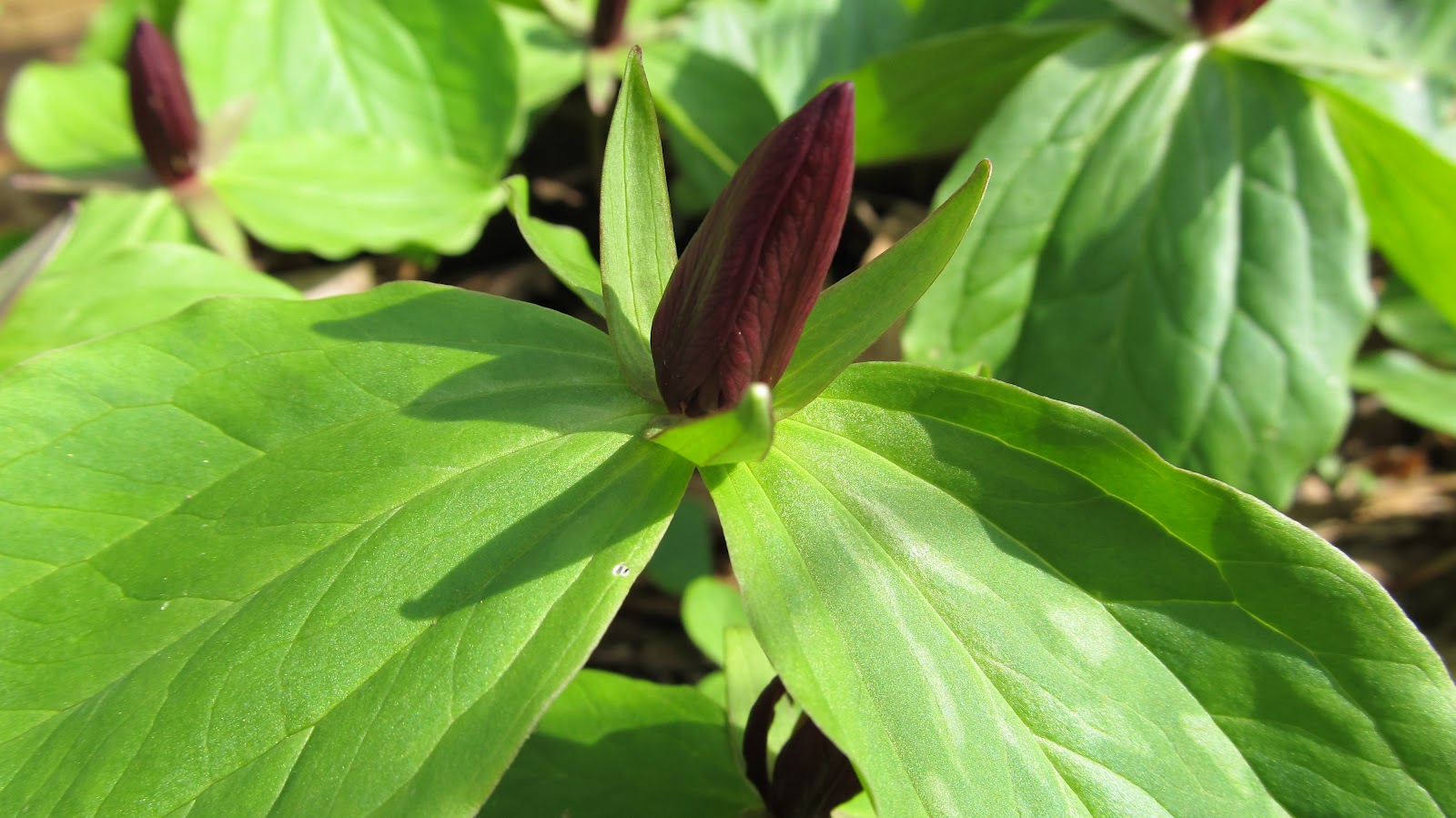
Trillium in Boyce woods / earrach 2012

Tuesday, March 20, 2012

What are you doing for EASTRE ?

Bloodroot  (Earrach, 2012)

Have you been asked this year? 

It seems so often that we're innocently approached by our coworkers or relatives not aware of our religious affiliations as if, as usual, everybody in the world is a good Christian, or at least one among those of the God-fearing Xmas n' Easter variety...

Well, but hey, wait !
- W H Y - N O T ?

Just like 
"YULE", 
the word 
"EASTER" 
has
NOTHING 
to do with 
anything Christian anyway...


Yep, if we'd just give up on that ubiquitous non-historical "Ostara" spelling** (it's always sounded too californicosmic for my tastes anyway) and go with the flow and get adjusted to the very old and non-christian word "EASTER," we'd start getting our point across, A.) to ourselves, and B.) to the rest of them. Yep, if we spell it in the archaic form "Eastre" and use the common pronunciation or something very close, we could, just as we've all been doing with Yule, begin reclaiming its power as "one of ours-in-the-first-place!"

Yes, EASTER is not a Christian word...

Only Christians speaking English or German use the word "Easter" for the celebration of Christ's resurrection. ALL the other languages use some variant of "Pascha". For all we know, the Dark-Ages missionaries from the British-Isles christianized the continent and brought the custom of using the old pagan name for spring/dawn with them from England.

Of course, in our local Neopagan tradition, our Eastre is celebrated at the Vernal Equinox itself, not, like their "Easter", the date of which they figure from the first Sunday after the first full moon after the Vernal Equinox (Eeeuuuuww! It sounds just so “heathen”, doesn't it?).

On a fixing a Neopagan THEME for the VERNAL EQUINOX

For over ten years now Sassafras Grove ADF has done a Vernal Equinox liturgical theme honoring the “Nerthus” Earth-Mother from the Celto-Germanic traditions of around 2000 years ago. The account we have of these traditions comes from the writings of Tacitus the Roman. Tacitus was writing about the people the Romans called “Germans”. In that time such distinctions were simply geographic territories, often defined by the Romans themselves. Whereas we have a notion of things “German” nowadays, many historians and archaeologists have come to agree that the cultural and linguistic distinctions were much less well defined then than they are now. Therefore they treat these territories as being essentially what they’d call “Late leTene-Celtic” or perhaps even “Celto-Germanic”. As Isaac Bonewits always said though, this is apparently the case with "most" modern scholars, "...except the German ones! "     ;-)....
------------------------------------------------
NERTHUS, the source text:  
from Germania (ch.40) by TACITUS the Roman, around the year c.e.98:


   " They have in common the worship of NERTHUS, 
   that is Mother Earth. They believe She is interested in 
   humanity’s affairs and drives about among them. 
   On an island in the Ocean sea there is a sacred grove 
   wherein waits a holy wagon covered by a drape. One 
   priest only is allowed to touch it. He can feel the presence 
   of the Goddess when She is there in Her sanctuary and 
   accompanies Her with great reverence as She is pulled 
   along by kine. It is a time of festive holiday-making in 
   whatever place She deigns to honour with Her advent 
   and stay. No one goes to war, no one takes up arms, 
   in fact every weapon is put away: only at that time are 
   peace and quiet known and prized until the Goddess, 
   having had enough of the people’s company, is at last 
   restored by the same priest to her temple. After which, 
   the wagon and the drape, and if you are like to believe 
   me, the deity Herself are bathed in a mysterious pool..."


Particularly noteworthy for us is the fact that of the seven tribes named by Tacitus as sharing the Nerthus traditions, only three are recognizable to modern scholars(1.), and one of them is very familiar, the "Angli": that is, the "Angles", progenitors of the Anglo-Saxons to emerge hundreds of years later.
BURIED IN SEPTEMBER, UNEARTHED IN MARCH;
OUR LOCAL NERTHUS / EASTRE TRADITION

There are no actual historical connections that I am aware of for fixing the honoring the Earth, Magna Mater, Nerthus, Gaia, etc. at or around the time of the Vernal Equinox (She is with us all year-round of course...). In our work it has just seemed very sensible to do so and it has become our custom.

A rich expression of this current, unique to our group, is the tradition of burying our oaken Nerthus-idol every year in the ground of someone’s garden at the very moment of the Autumnal Equinox and then leaving her there until we unearth Her again six months later, at the very moment of the Vernal Equinox. Once dug up we carefully bathe her and anoint her with fragrant oils and, in keeping with Tacitus’ story, we then set her up in her little wagon and she goes “abroad among the people” throughout our community, visiting our various home shrines and traveling with us to visit other groves through the six months she spends “topside” every year.

HONORING EASTRE,  an alternate Vernal Equinox theme...

Another yet still legitimately Northern / Central European based theme could be an equinox rite to EASTRE Herself (- Eostre, Ostre, etc.). It’s the same word as “Easter” and it’s at least as legitimate as the word "Yule" is for us to reclaim it as “one of ours”. It's very likely the word may have been used by the pre-Christians to mean springtide and has no linguistic connections to the terminology of Christianity whatsoever. As a goddess of beginnings, spring, the dawn, and-or the east, She can be called upon as a highly appropriate alternative to Nerthus as the deity-of-the-occasion, especially when scheduling calls for our public event to fall just before the actual equinox. The theme of the dawn-goddess Eastre's promise of Nerthus' immanent rising fits perfectly. Why, with the inescapable eggs, bunnies, crocuses, the works - - there’s no real stretch there, eh?

But was this "EASTRE" really worshiped as a goddess?

As to who Eastre "was", and even as to who may have worshipped her and when? Honestly, that stuff is very unclear. As a matter of fact, you’d be safe to trust no source that even mentions her as a "goddess" with any surety - She's that archaic. Other than one brief citation in Bede's de Temporum Ratione (8th Century), there are I believe no accounts in the ancient record by contemporaries referring to Her as an actual goddess being worshipped by their own people or others within memory. The roots of why She is generally counted by scholars as probably having been a deity are more linguistic than anything else. Eastre may have meant "the Beginning" (of life; i.e., the "dawn" thereof) yet we don’t know which came first: Eastre the goddess –or- Eastre, a word for "Springtide".
SO, the Christians fixed the Feast of the Passion and Resurrection from connections in their story with Passover. The Jews set the date of Passover from the first full moon after Vernal Equinox. Somewhere in the first 1000 years of Christianity the paschal theme became synonymous with this time of year - hence the Christians’ appropriation of the totally non-Christian word eastre from the Germanic tongues of which English is a member yet all of the non-Germanic languages of Europe have “pascha” as the root of their name for the feast of Christ’s resurrection with no sign of anything like “easter” at all. 

Could the English actually have brought the designation "eastre" to the German Christians? 

Some recent readings (Where had I seen this? It's out there; please help me source this!) have suggested that the reason for this is that in the "Dark Ages", while the earlier continental Christian missions had actually failed and their territories had largely lapsed back into paganism, it was a second wave of Anglo-Saxon Christian missionaries from Britain who finally established the ongoing foothold in Germany, using the far more successful strategies of the insular church. These Anglo-Saxon monks may have brought with them the custom of using the Anglos-Saxon term "Eastre" from their vernacular and it stuck. 

RELEVANT LINKS:


FUZZY LOGIC solves the endless dispute over “when” a season begins or ends !

BREAK  A STICK in half at the sacred moment and nab some big Mojo? see:

The DRUIDS’ ALMANAC – lots more related fun stuff here:

-------------------------------- 
* * "OSTARA"  - is a form found everywhere these days in Wiccan literature 
but actually found nowhere in the ancient record. The word Ostara was first suggested in the 1840's by the Brothers Grimm as their speculation of how it -may- have been spelled in ancient Germany. Bede's citation (De Temporum Ratione, 730 C.E.) of the name Ostre or Eastre seem to be the oldest historical mention to be found, yet he nor any other historical source give the "ostara" spelling.
-------------------------
Professor RONALD HUTTON on Bede's references to Eastre:
"There remains, however, the problem of why the Germanic-speaking areas of Europe, in sharp contrast to the others, did not derive their name for this celebration from the Passover, but from a term which is rendered into modern German as Ostern and modern English as Easter. On the face of it, the issue ought to have been solved by Bede in the early eighth century, as part of his work on the calendar mentioned earlier.5 He declared that the name had derived from that of a goddess, Eostre, after whom the month in which Easter fell had been dubbed the ‘Eostur’-month. This passage has been so often quoted without any inspection or criticism that it is necessary to stress that it is subject to all the reservations lodged by Tille against Bede’s assertions concerning the ‘Mother Night’, cited in the section dealing with Christmas. It falls into that category of interpretations which Bede admitted to be his own, rather than generally agreed or proven fact. A number of German scholars cast doubt upon its utility during the nineteenth and early twentieth centuries, although not with sufficient evidence to disprove it in turn. Two facts do seem to emerge from the discussion. One is that versions of the name given by Bede were used widely among speakers of Germanic languages during or shortly after his time; thus the Christian festival was known as Ostarstuopha in the Main valley during the eighth and ninth centuries. The other is that the Anglo-Saxon eastre, signifying both the festival and the season of spring, is associated with a set of words in various Indo-European languages, signifying dawn and also goddesses who personifed that event, such as the Greek Eos, the Roman Aurora, and the Indian Ushas. It is therefore quite possible to argue that Bede’s Eostre was a Germanic dawn-deity who was venerated, appropriately, at this season of opening and new beginnings. It is equally valid, however, to suggest that the Anglo-Saxon ‘Estor-monath’ simply meant ‘the month of opening’ or ‘the month of beginnings’, and that Bede mistakenly connected it with a goddess who either never existed at all, or was never associated with a particular season but merely, like Eos and Aurora, with the dawn itself.6 With the removal of this shadowy deity from the canon of historical certainty, there evaporates any reliable evidence for a pre-Christian festival in the British Isles during the time which became March and April.7 It may be that there was none, the ancient inhabitants being wholly taken up with ploughing, sowing, and caring for young livestock. Alternatively, some of the later Easter rites and customs may echo practices which attended old feasts of which we have now lost sight. Of one thing alone it is possible to be confident; that, although the timing of the feast of the Resurrection was dictated by historical accident, it could not have fallen at a more appropriate point of the European calendar, when so much in nature conduced to a mood of celebration and renewal.
-----------------
Hutton, Ronald (1996). Stations of the Sun: A History of the Ritual Year in Britain (pp. 180-181). Oxford University Press. 

Sunday, February 26, 2012

Of Ancient Celts and Microwave Ovens


Some time ago there came a posting in one of our forum discussions:
-------------------------------------------------------------------------------------------
" I agree and it is accepted scholarship that there were no festivals
around the solstice and equinoxes and that these celebrations are a
modern concept.
There is evidence however that the ancient celts* may
have marked some of these days. This comes from stone structures
that mark these events...Newgrange being the most popular."

-------------------------------------------------------------------------------------------
*the writer here meant to say "Neolithic peoples of Britain and Ireland"; 
the ancient Celts were around only back at the half-way point on a timeline 
stretching from our time back to the Neolithic people who built New Grange and Stonehenge...

...I -had- to reply:                             
              
1.) I feel there's really too little known about the Celts to assume anything so comprehensive about their calendars. The Coligny calendar is an amazing artifact which is definitely Gaulish but strongly affected by their exposure to Roman culture. There are a number models for its interpretation but it's far from a closed case. Even if one or more of those come close to the mark, what then does it tell us about "The Celts"? The Gauls maybe...

2.) I'd also suggest that modern 'scholarship' has no real evidence that the solstices and equinoxes were -not- known and celebrated by the Celts either.

They may have had a system of musical notation: we don't know that they didn't.
They may have had really funny jokes about hedgehogs: we don't know that they didn't

They may have had microwave ovens: we also don't know that they didn't.


The latter of course simply being more unlikely, yet the point of contention about the calendar is statements inferring that "The Celts" didn't have religious celebrations for the solstices and equinoxes and did not base the structure their year on a solar astronomical pattern... Sometimes, to me, that they didn’t seems as unlikely as that they had microwave ovens. Contemporary "scholarship", represents a spectrum of quality and rigor and much of modern Celtic scholarship is still rife with unconfirmed assumptions and traditionally-parroted factoids.

It is a commonly made observation that the body of Irish and Welsh literature (only 500 to 1200 years old and written-down by Christian monks) mentions Imbolc, Beltaine, Lughnasa and Samhain almost exclusively. Yet I think there's only one known citation** which actually mentions all four together. But oddly enough, the same mass of unrelated documents hardly ever seems to mention the Christian feasts with the "solar” dates... You know: The Nativity in December, Lady Day/Easter in March, the Feast of St John in June, and Michaelmas in September... but you see, THESE DATES HAVE BEEN THROUGHLY “SCRUBBED” of any pagan lore by the popular Christian feasts which supplanted them and this is particularly likely in the cases of the Yule Solstice and Easter equinox.

These, to a greater or lesser degree, were already long obscuring anything that may have preceded them historically. Certainly this effect was evident in the so-called "fire-festivals" as well: St. Bridget's; Walpurgis, Lammas, All Hallows...

I feel that one should try to reckon-in the fact that the 'fire festivals' managed to still "stick-out" - a little more since they were significantly less the subject of the erasure-by-proximity factor than things like Christmas, Easter, or the Feast of St.John (a.k.a Midsummers, one of the HUGEST pan-European celebrations of the folk-year yet hardly given credit as such in the NP literature).

And very much to the point of our discussion, there is an unnoticed but active bias/spin-factor afoot in the use of the term "fire festivals" instead of the more historically compelling term "cross-quarter days". Hmm, what "quarter days" are those "cross-quarter days" astride and crossing? Well? Allowing students to model the Celtic feast cycle as a pattern of two or four(if it ever was a "pattern"...) without giving a nod to the framework of the astronomical year which neatly frames them-in with ITS skeleton of two or four NON-arbitrary global/solar calendrical "events" is in my mind just shameful tunnel-vision. The solar cross of St. George provides the sole justification for the cross of St.Andrew standing astride it; yes, it's what I've always thought of as the the Druid Mystery of the Union-Jack (Masons? Illuminati? Moste Anciente Cabal of ye Republican Astronomers?). The solstices and equinoxes are the factual underpinning of the natural year and can be seen as the very seat of our religious mysteries - and, in their directing all cycles of life and climate foundationally, we find they are there, at least skeletally, supporting the mythic patterns of most cultures around the world...
Denigrate the solstices and equinoxes? - -  BAH ! - HERETIC !

Yep, we love Celtic stuff... yet, sometimes, I can't help feel that it's because there's so little known about it with certainty.
- Earrach
-------------------
**see Tochmarch Emer
(The Wooing of Emer) paragraph 27: http://www.ucc.ie/celt/published/T301021/

RELATED POSTS:  "On the Origins of the Cross-Quarter Days" 

Tuesday, January 31, 2012

Brigid and Smithcraft ?

On the relevance of Brigid as Matron of Blacksmiths

It is my contention that although blacksmiths and forge-workers of old may have held Brigid to be their patron deity (matron) due to her association with the hearth, "smithcraft" was not representative of her spiritual aspects beyond that association.

Would we say that automobiles should be an emblem of Saint Christopher? Well, for the better part of the 20th century, millions of Roman Catholics world-wide had a little plastic statue of St.Christopher on the dashboard of their cars and/or a St. Christopher medal hanging from their rear-view mirror. So, is an automobile a religious symbol of St. Christopher? Is Jesus to be given the epithet "grave-god" because the graveyard is full of crosses?

I would hope you'd answer: "Er, um, well, sort-of but... I suppose no, not exactly..."

The primary story recalling the mythic-identity of Saint Christopher ("Christ-carrier") was that he once unknowingly carried a wayward child safely across the raging torrent on his shoulders and this tattered child, greatly impressed with his kindness and bravery, turned out to be the Lord Himself. As a consequence, Catholics everywhere ascribed to him the role of Protector of Travelers. 

Squadrons of desperate mothers, tens, no, hundreds of thousands, prayed every night to St.Christopher, begging for his intercession with the Lord to protect their sons on their travels overseas, and so it was through several of the wars in the last century. Alas, in later years albeit still hugely popular, the Church decomissioned him, as presenting far too-little historical data to support his actual existence, relegating him to the dust bin of apochrypha.

BRIGANTIA: Protectress and Sovereign

Brigid is almost exclusively rubber-stamped for us these days in the popular Celtophernalia as "a goddess of Poetry, Healing and Smithcraft" and it is the smithcraft I would take to task here. We have no Irish Gundestrup or Reims icons to compare and review here, no Scythian or Roman craftsmen to fossilize some cross-cultural clues for us... None* but one; the Romano Celtic shrine to Brigantia from north Britain...
Brigantia shrine from Birrens, Dunfriesshire

Above is an 1800 year old artifact bearing an image which we should cherish and hold central to our quests for understanding Her. Yet, somehow, it remains largely overlooked. Yes, the iconography here is almost completely Roman, calling her Brigantia, but portraying her as a sovereignty goddess with a full set of the attributes of Minerva: the spear and shield and the Aegis on her breastplate, and in her hand, the orb as a symbol of her universal rulership. You may recall having seen this particular icon, but honestly, just how often? Why so infrequently?

The Minerval aspect of Brigid accounts for or at least informs many of the bits of lore we have from the Irish and the Scots. The protectress function not only sees her as a guide and guardian of armies and nations but figures equally well in her inspiration to mothers and house keepers as foster mother, blesser of the home-hearth and protector of door, wall and roof. As inspiratrix she guides the creative with her flame of wisdom. As the emblem of the soul of the nation of Ireland to this day and more anciently of Britain, there is little question of her function as a goddess of sovereignty...

But, as usual, instead we are plastered (wattle and daubed?) with the same couple of fragments of Brigid-lore from the Irish hero tales, the sources for which only rarely exceed the first thousand years before our time. Younger yet, the remaining body of lore attributed to Her is actually booty from raids made by the wishful-thinking upon the lore and folkways attributed to the quasi-historical Christian saint bearing her name. I must confess I often have pillaged therein myself, particularly in the wonderful appendices to Campbell's Carmina Gadelica. That material, as beautiful and evocative as it is, bears its unshakable Iron Age pedigree only in that it was field-collected from Scottish folk traditions alive in the years stretching from the time of Charles Dickens through the reign of Queen Victoria. Yes, back when Lady Gregory carried her tablets down from Ben Bulben, summing up for us forever after the three primary aspects of Brigid as "Poetry, Healing, and Smithcraft"...

Quite simply: a Goddess of the Hearth and the sanctity of Fire

There seems to be a significant number of references to the quasi-historical saint, or dearly hoped-for "Celtic Goddess", which indicate an association with fire, and in particular, sacred fires, and a strong and potentially very old set of household hearth-customs, the common ground there being specifically fire-based prayers and ritual activity. Again I will admit to falling back on my own intuition and syncretic tendencies (and some 25 years of ritual experience with Her) and I continually emerge with the conclusion that a primary component of Brigid's identity was focused on the sanctity and utter indespensibility of fire and as such it brought Her veneration to a central, veritably axial, role in every home, first then and foremost as a Goddess of the Hearth.

In my mind, Brigid was likely no more a goddess "of smithcraft" than Saint Christopher was a saint of automobiles.


Certainly She would have been held by the blacksmiths and forge-workers as their patron. The anvil, hammer, and tongs may have been their connection to Her but this only because they were daily workers at a hearth. But proportionally, who worked at hearths? Let us not forget that for every single blacksmith west of the Rhine in the last 2500 years, there were untold millions of housekeeper cooks, working their daily magic, and even more populous yet came all those damp and shivering souls, stumbling in from the cold to huddle-before that blessed radiance glowing at the center of every home, eagerly drawing upon Her power to comfort and heal, to protect and inspire.

------------------
* well actually, this "one" seems to be the model or best realized from among several extremely similar but more crude Brigantia-relief versions from the same area and period in the south of Scotland.


Saturday, January 7, 2012

My Druids' ALMANAC, 2012

(NOTE: the 2014 Druid's Almanac is up and can be found HERE instead)


The WHEEL of the YEAR,  2012...
To download a printable PDF 
of the above, click HERE.
 
ALERT: CORRECTED VERSION (v1.02) now displayed above and below; 
a pair of typos were discovered on Jan12, 7pm Eastern
(Lughnasa time and AutEqx date on previous post were incorrect )

Please help me proofread this page; alert me to any typos you find asap.  Thanks, - E.


The Book of Sassafras 
DRUIDS' ALMANAC Miscellany...
The full series of Druid Almanac charts, essays and resources is found

--------------------------------------------------------------------------------------------------------------

Saturday, December 31, 2011

And so turns the year - Listen !


The scene is a familiar one: it's New Year's Eve; a party, perhaps at your home or perhaps at a friend's. There are many friends there, old and new, as well as many faces you don't recognize. The time is drawing close to midnight; the television is on and the traditional sounds and images capture the attention of your little gathering... Times Square, New York City is a surging sea of people. A stream of numbers tumble across the screen, peeling off the last minutes and seconds of the old year. On the screen, the passions of the crowd grow stronger, the excitement is infectious and obviously affecting your companions. Most of the people around you are now transfixed by the inane but indisputably powerful imagery pouring out of the television. A few of your neighbors forcibly break free from their trance to check their watches; you notice and perhaps you are compelled to check your own. The world plummets onward through the last remaining seconds while, on the screen, the crowd now whipped to an ecstatic frenzy, joyously roars in celebration of a simple ball sliding down a pole.

Usually at this point, I've already run out to the front porch or into the front yard. I've done this for virtually as long as I can remember; for this is certainly the most magical moment of the year. For a brief minute or two a whole time-zone of people, from Canada all the way down through South America, are locked in synchrony! The combined emotional / psychic power of tens, no, hundreds of millions of people celebrating the same moment in much the same way, experiencing much the same sentiments - - Well, the concept has always just staggered me. The front yard? Oh yes... You see, standing outside, away from those interior components of the moment, one can experience the most exquisite thing...   

you can hear the year turn !

There are always plenty of early-birds who start during the actual count-down, so at first you can hear its approach. Distant and occasional, then closer and more persistent it comes. Shouts, fireworks and gun-blasts, and all around you comes the glorious clattering Old World echoes of the beating of pots and pans, car horns and more shouts... Eventually the peak of the tumult passes over and then a few more fireworks and the occasional gun-blast and maybe a last distant car-horn. You can almost see Him (I swear I have...), the great Old Man, striding from east to west across the sky, stopping halfway to shake hands with Orion, then hobbling onward to finally fade and disappear into the western stars. And, as we finally lose sight of Him, there arises from all directions the half heard whisper of a million storm-doors slamming themselves shut... and perhaps, the one final closing we perceive before the shutting of our own door is that of the great one - hinged upon the very poles of the sky itself....            
-E.
Happy New Year !